How High-Net-Worth Investors Can Improve Wealth Outcomes Through Tax-Aware Portfolio Strategy
Many investors become heavily focused on investment performance while overlooking a more meaningful measure of success: after-tax returns. For high-net-worth individuals, tax-efficient investing is paramount to developing an appropriate investment strategy across taxable and tax-advantaged accounts to maximize your profits. Tax-efficient investing is not simply about seeking higher returns but improving the amount of wealth you keep. By understanding how different investments are taxed and incorporating tax-aware portfolio construction, investors can often enhance long-term outcomes without necessarily assuming additional market risk.
What Is an After-Tax Return?
An after-tax return represents the amount an investor retains after accounting for investment income, realized gains, expenses, and taxes. A simplified example illustrates the concept:
Assume an investment appreciates by $500 and generates an 8% return. If the gain is taxable and subject to a 35% tax rate, the investor retains $325 after taxes, resulting in an effective after-tax return of 5.2%.
This difference highlights an important reality: Pre-tax performance and real investor outcomes are not always the same. For affluent investors, taxes often become one of the largest variables affecting long-term wealth accumulation.
Why Tax Treatment Matters
Investment income is not taxed equally. Different investment types receive different tax treatment under federal tax law, and for high-income households, surtaxes and state taxes may further influence after-tax outcomes.
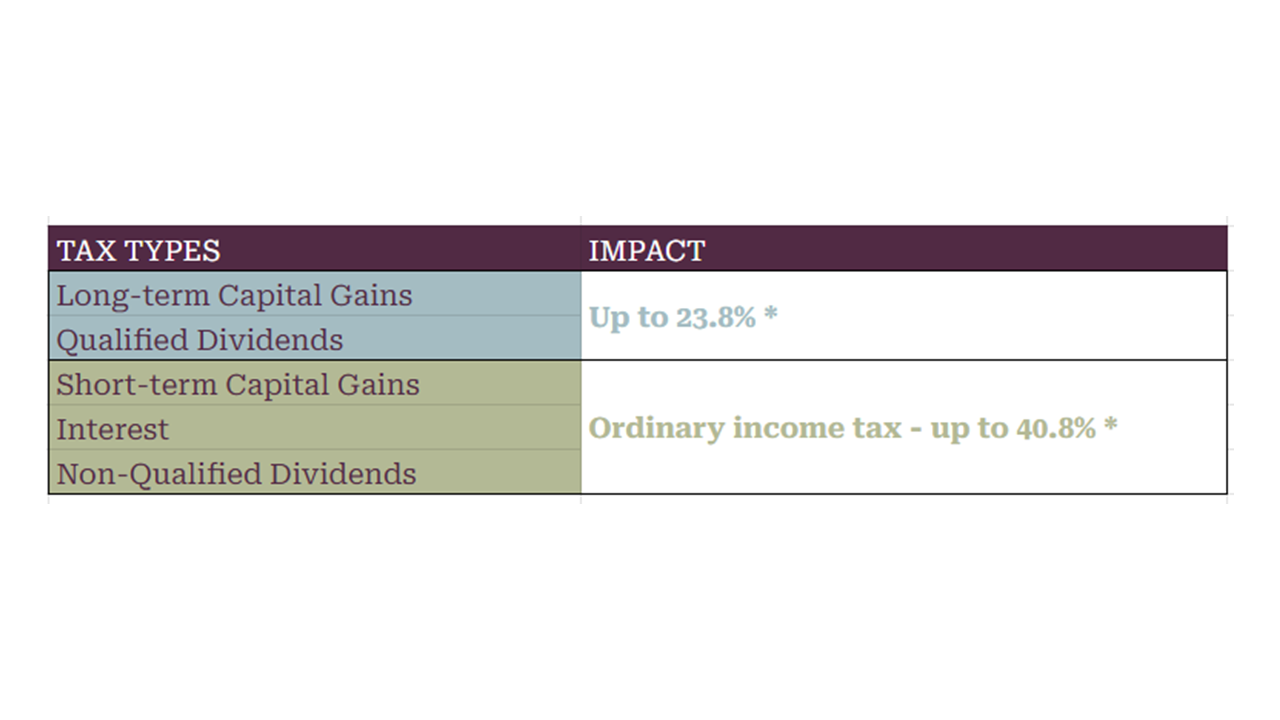
* Includes 3.8% Medicare surtax, aka Net Investment Income Tax (NIIT)
Tax Treatment by Investment Type
Understanding how various asset classes are taxed can help inform a more tax-efficient investment strategy.
Bank Savings Accounts and Certificates of Deposit (CDs)
Interest earned from high-yield savings accounts and certificates of deposit is generally taxed as ordinary income at federal rates and may also be subject to state and local taxation.
Although these vehicles may provide stability and liquidity, their after-tax returns can be less attractive for investors in higher tax brackets.
Stocks
Stocks receive different tax treatment depending on holding period and dividend classification.
Short-Term Capital Gains (STCG): Investments held for less than 12 months are generally taxed at ordinary income tax rates, which may substantially reduce after-tax returns.
Long-Term Capital Gains (LTCG): Stocks held for more than one year benefit from preferential long-term capital gains rates. For high income earners households, this typically means a 20% federal capital gains rate, and oftentimes the potential 3.8% NIIT.
Dividends: Dividend income also receives different tax treatment. Qualified dividends generally receive favorable long-term capital gains tax treatment. Non-Qualified Dividends are typically taxed as ordinary income.
Importantly, dividends remain taxable in the year earned regardless of whether they are reinvested or distributed as cash.
Bonds and Fixed Income
Bond taxation variers based upon the type of bond, your total taxable income, and whether you sold it prior to maturity. For high-net-worth investors, understanding these distinctions can be particularly valuable when constructing fixed-income allocations.
U.S. Treasuries and Savings Bonds: Interest earned from Treasury bills, notes, bonds, and many U.S. savings bonds is generally taxable at federal ordinary income tax rates but typically exempt from state and local income taxes (SALT). The state tax exemption can improve after-tax returns for investors residing in high-tax states.
Treasury Inflation-Protected Securities (TIPS) are fixed-income government bonds designed to help preserve purchasing power. Their principal value adjusts with inflation as measured by the Consumer Price Index (CPI). While interest income is taxable at federal ordinary income tax rates, their value is measured by keeping pace with inflation, thus improving your purchasing power. And they are fully exempt from state and local taxes.
Municipal Bonds may offer meaningful tax advantages for investors in higher tax brackets. Interest income is generally exempt from federal income tax and may also be exempt from state income tax when issued within the investor’s home state. This favorable tax treatment often makes municipal bonds attractive for taxable investment accounts and tax-aware income strategies. However, capital gains and certain private activity bonds may still be taxable when sold.
Corporate Bond interest is generally fully taxable at federal, state and local levels.
If bonds are sold prior to maturity, any gains or losses may trigger capital gains taxation depending upon the holding period.
The below is for illustrative purposes only. Actual after-tax outcomes depend on tax bracket, investment type, holding period, state taxation, and applicable surtaxes.
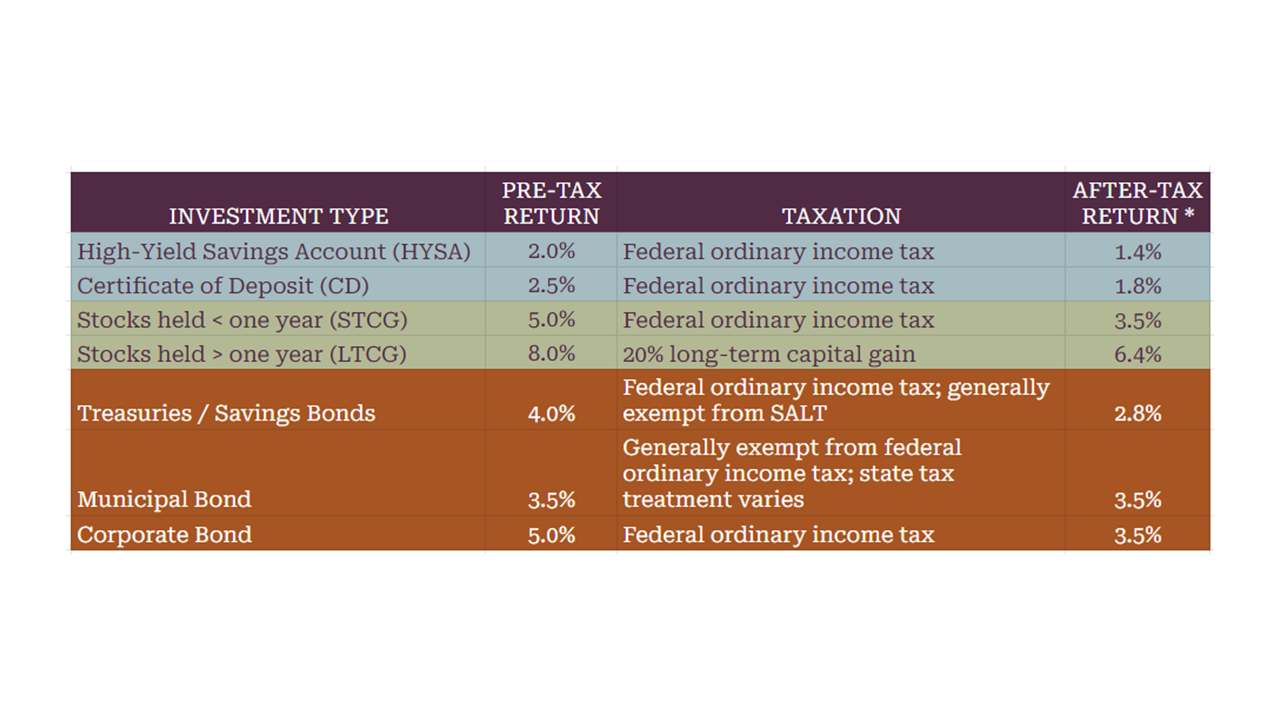
* Assumes 30% marginal ordinary income tax rate, 20% long-term capital gains rate, no state income tax, no 3.8% NIIT
Final Thoughts
Successful investing is not determined solely by market performance. For high-net-worth investors, portfolio outcomes are shaped by a combination of investment returns, tax efficiency, expenses, and disciplined portfolio management.
Tax-aware investing considers not only what you earn, but what you ultimately retain. This may include:
- Positioning tax-inefficient assets inside retirement accounts
- Utilizing municipal bonds where appropriate
- Managing capital gains exposure
- Minimizing unnecessary portfolio turnover
- Selecting low-cost investment vehicles
- Coordinating investment strategy with broader tax and wealth planning objectives
Because income levels, state taxation, and account structure can significantly influence outcomes, evaluating investments through the lens of after-tax returns may lead to more informed and durable wealth-building decisions.
When thoughtfully integrated into a comprehensive wealth strategy, tax-efficient investing can become a powerful tool for preserving and compounding long-term wealth.